Wolt Courier Partner App -Designing the preferred platform for couriers
ROLE GROUP STAFF DESIGNER
YEAR 2020 - 2025
Wolt / DoorDash international is a local commerce platform that connects people looking to order food, groceries, and other goods with people interested in selling and delivering them. Wolt operates this three sided marketplace in 27 countries and counting.
The Courier Partner App is a crucial part of this tripartite along with Consumer and Merchant apps. Delivering the products and services sold.
Couriers operate in a wide variety of roles in cities and conditions with varying backgrounds, needs and ambitions - in a world of edge cases the platform needs to support these equally.
While the Wolt platform has always been well-liked and the courier app constantly reaching 4.7 - 4.8 ratings in the app stores, the app was beginning to struggle to cater for ever more complex needs of the partners and growing business.
As a core member of the Courier Design Team, I led ongoing exploration, definition, and iteration of the courier app’s product design and user experience.
My scope spanned both directional and feature-level work, alongside foundational improvements to the components and patterns and their systematic use, helping teams ship quality consistently across the group as it scaled.
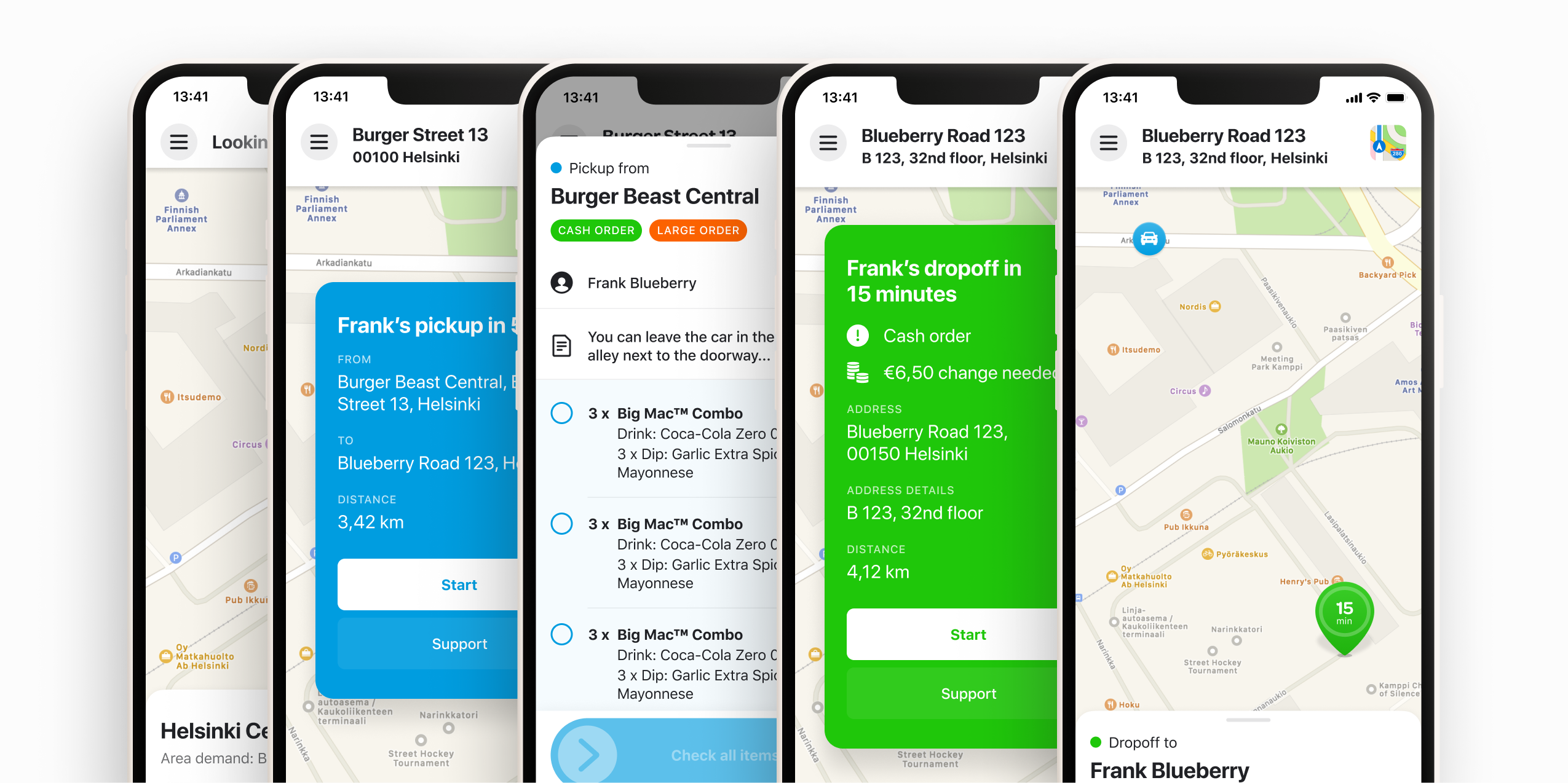
LEGACY COURIER PARTNER APP
From functional product to scalable platform
While the app effectively met the immediate needs of the business and delivery partners, the core challenge was structural: it was not a future-capable platform, nor did it provide a systematic foundation to become one.
The product had been designed around a narrow use case, primarily pre-paid restaurant deliveries with relatively simple compensation logic. As the business expanded and operational complexity increased, this model became increasingly outdated.
Over time, design and engineering debt accumulated as new features were layered quickly on top of existing ones. This resulted in a system that was difficult to scale and adapt.
Additionally, a lack of detailed documentation on the app’s features and the logic behind initial decisions would lead to extensive questions and research initiatives. A cost of a startup moving fast.
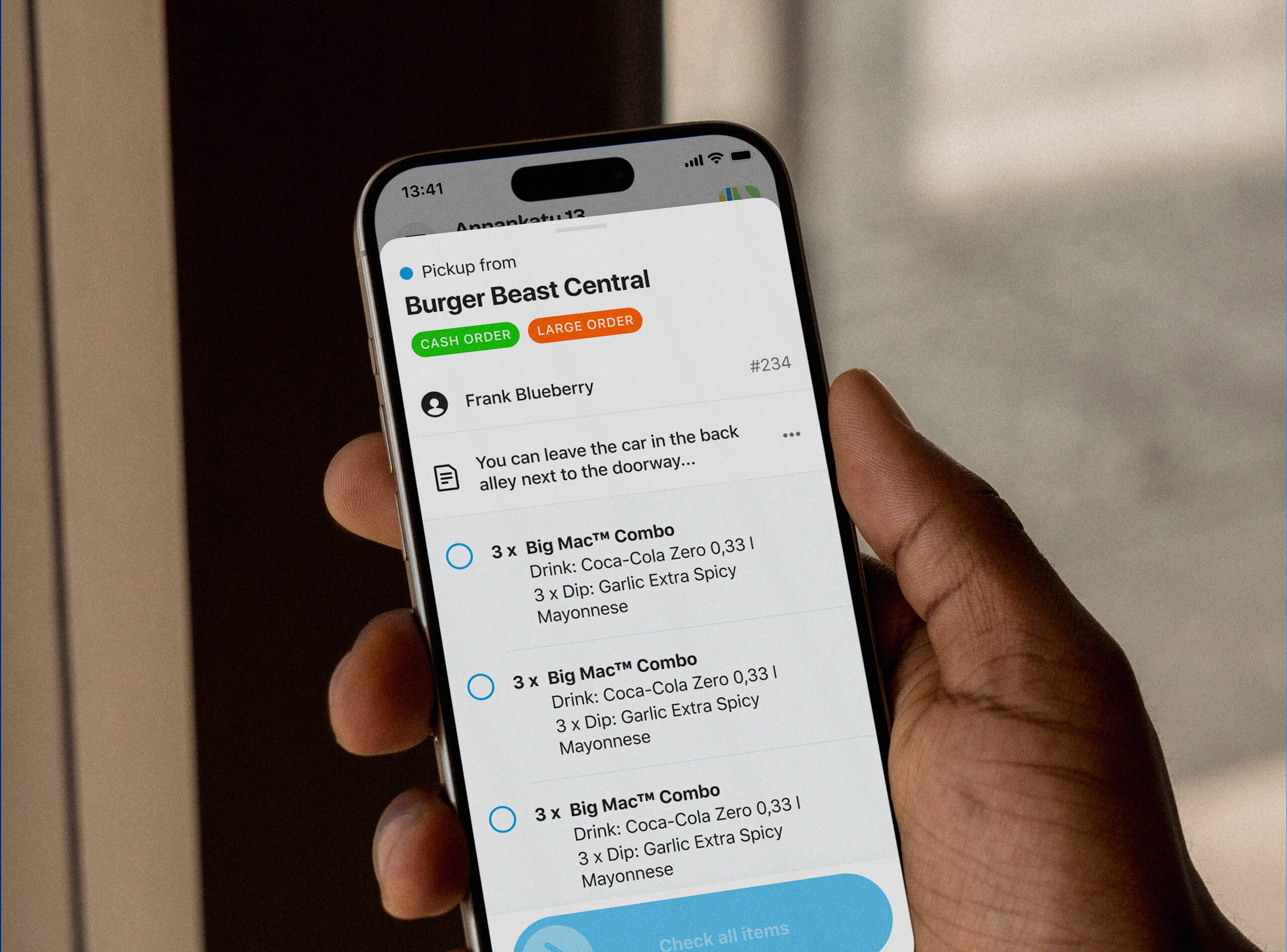
So how might we design to provide a first class delivery experience for consumers, be the most loved platform for all our partners, and be the most efficient logistic engine in the industry?
While serving the current business and partner needs without interruption.
What are the key design needs now and what are further requirements already on the horizon? What are the unknowns?
From design POV, what are the fundamentals and core principles to build on?
Having access to, with constant feedback loops, to key stakeholders such as Country Operations Teams, who run the day-to-day operational side of the business, dedicated courier and customer support functions and continuous feedback from couriers through the app were very insightful into immediate needs and pain points - and to start answering the above.
In addition we spent considerable time on research initiatives, courier partner interviews, shadowing courier support as well as working courier shifts, delivering orders to get a first hand feel , empathy and to understand the physical work environment, as well as to recognize the gaps in their expectations from us.
A practice that was repeated every few months.
Evolving research functionality in the group as well as access to DoorDash research would become invaluable later in benchmarking and gauging similar problem spaces, hypotheses and solutions.
Foundations and direction
Beyond Wolt's design & experience principles, additional directional and foundational design POVs were indentified early and refined continuously over time. These served as clear targets to validate both strategic direction and day-to-day feature work:
A continuous focus on delivering a fundamentally better user experience for our partners.
Move from a toolish approach to a more consumer-like experience that that better aligns with the brand and other products on the Wolt platform.
Design towards delighting our users - better use of screen real estate, contextual information, automation and motion.
Prioritize transparency by surfacing the right information at the right time, enabling informed decision-making and improved operational efficiency.
Aim for robust, unified structure and design that scales for future implementations - systematically.
Continuously refine the core delivery and task loop, while ensuring readiness to expand into new services..
Reduce inbound support contacts with self service options for our partners.
Designing for contextuality, transparency, and scale
The Courier Partner App makes it possible for couriers to work and earn money on the Wolt platform through:
1. The core business of receiving and completing tasks & earning compensation for them.
2. Support and accompanying views and functions to help couriers see and manage their work.
While contextuality, expandability, and a strong systematic foundation are unifying themes, the needs and urgency across these areas differ.
The first area focuses on supporting a growing variety of task types, both current and future. Couriers must be able to make informed decisions on the move and complete tasks with clarity, confidence, and efficiency.
The second area focuses on helping couriers make better decisions about when and how they work, including understanding conditions, increasing earnings, and meeting personal targets. It also supports long-term growth, partnership, and a sense of community through transparent and easily accessible information.
Unlocking decision-making at app launch
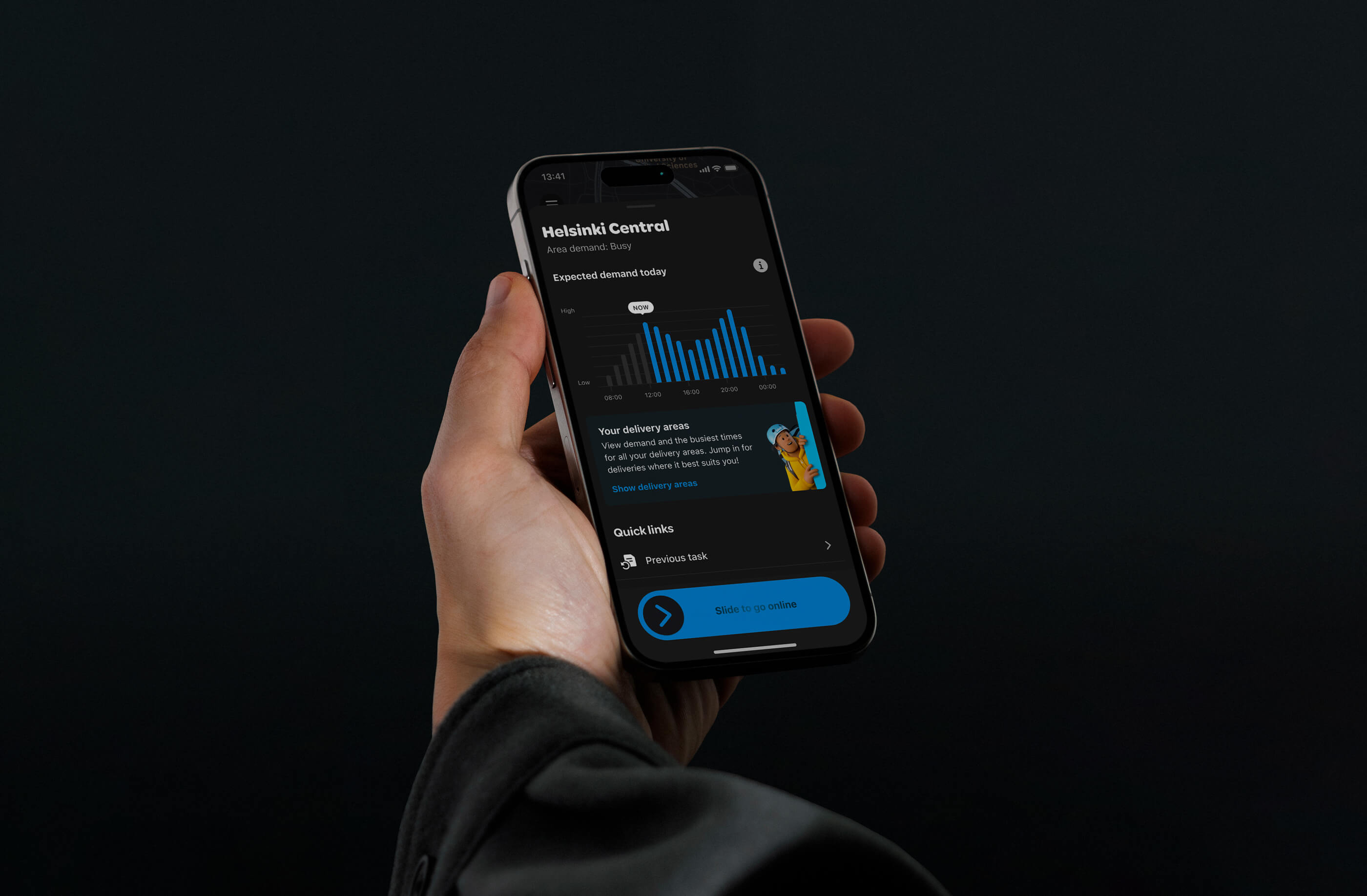
The app launch experience was identified as a key moment to provide timely, relevant information before couriers come online for tasks.
Previously, couriers had limited visibility into demand or area conditions at launch. This meant there was little support for informed, real-time decisions about whether it was a good time to go online, or whether waiting would lead to better earnings.
We introduced a productized view of delivery area conditions and demand, initially for freelance couriers. This enabled them to assess current conditions and make a deliberate choice about when to come online, effectively incentivizing availability during high-demand periods and reducing unnecessary supply when demand was low.
Following its initial rollout in freelance markets, the experience was extended to employee couriers. The app launch flow was adapted to support their specific needs, including shift information, mandatory breaks, contractual constraints, and partnership-specific requirements such as vehicle condition checks or identity confirmation.
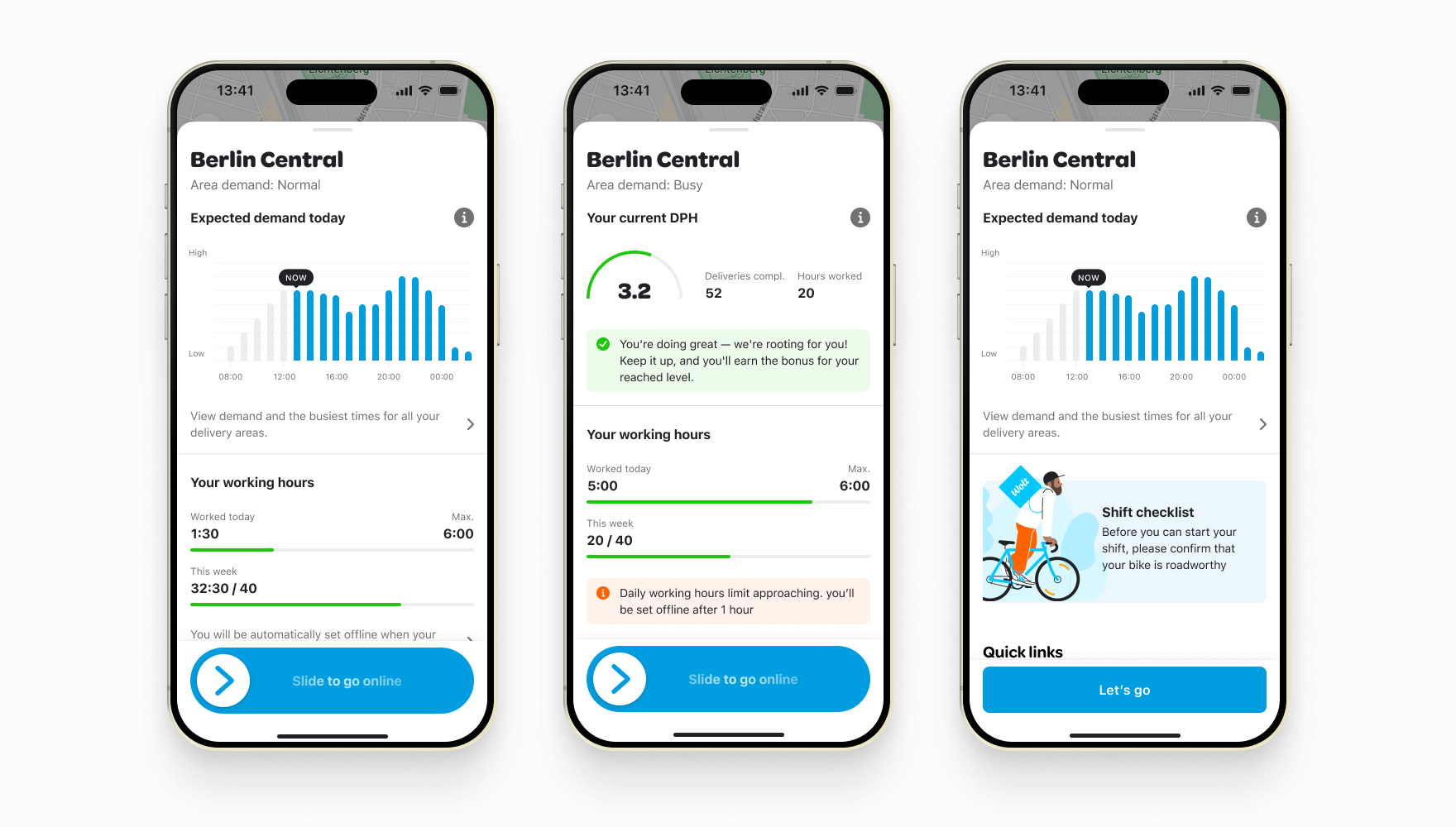
BEFORE GOING ONLINE SHEET VARIATIONS
The launch sheet was further expanded to surface important updates and critical service information directly in the app. Previously, much of this communication relied on external channels such as email, which were not always effective in reaching couriers in a timely manner.
The pre–go-online phase was also modernized with a stronger emphasis on contextual, well-timed push notifications and a clearer in-app communication hub, accessible both during launch and from the main navigation at any time. This replaced an outdated message-stacking solution that added friction and often obscured relevant information instead of supporting it.
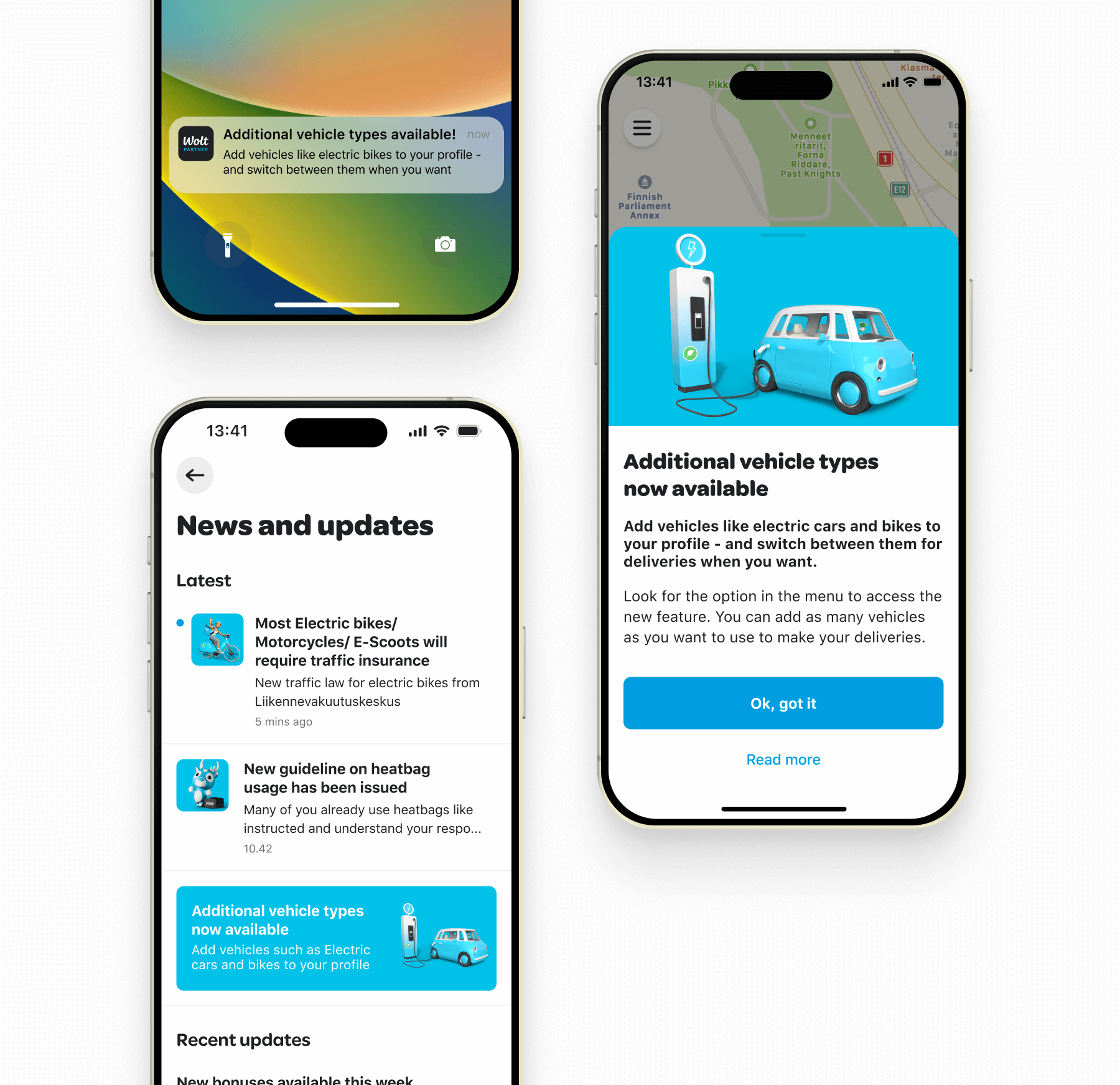
COURIER SERVICE COMMUNICATIONS
Continuously improving the core task experience
The core task experience - or delivery loop - the main or primary function at the heart of the service has four distinct phases:
Task offer - on pickup - on dropoff - task complete / Idle
These phases are continuously evaluated and improved both holistically and through parallel, focused workstreams targeting specific pain points.
As task complexity and information requirements increased, the legacy task offer modal began to show significant limitations. Performance issues emerged, including failures to accept tasks, which directly impacted courier trust and service reliability.
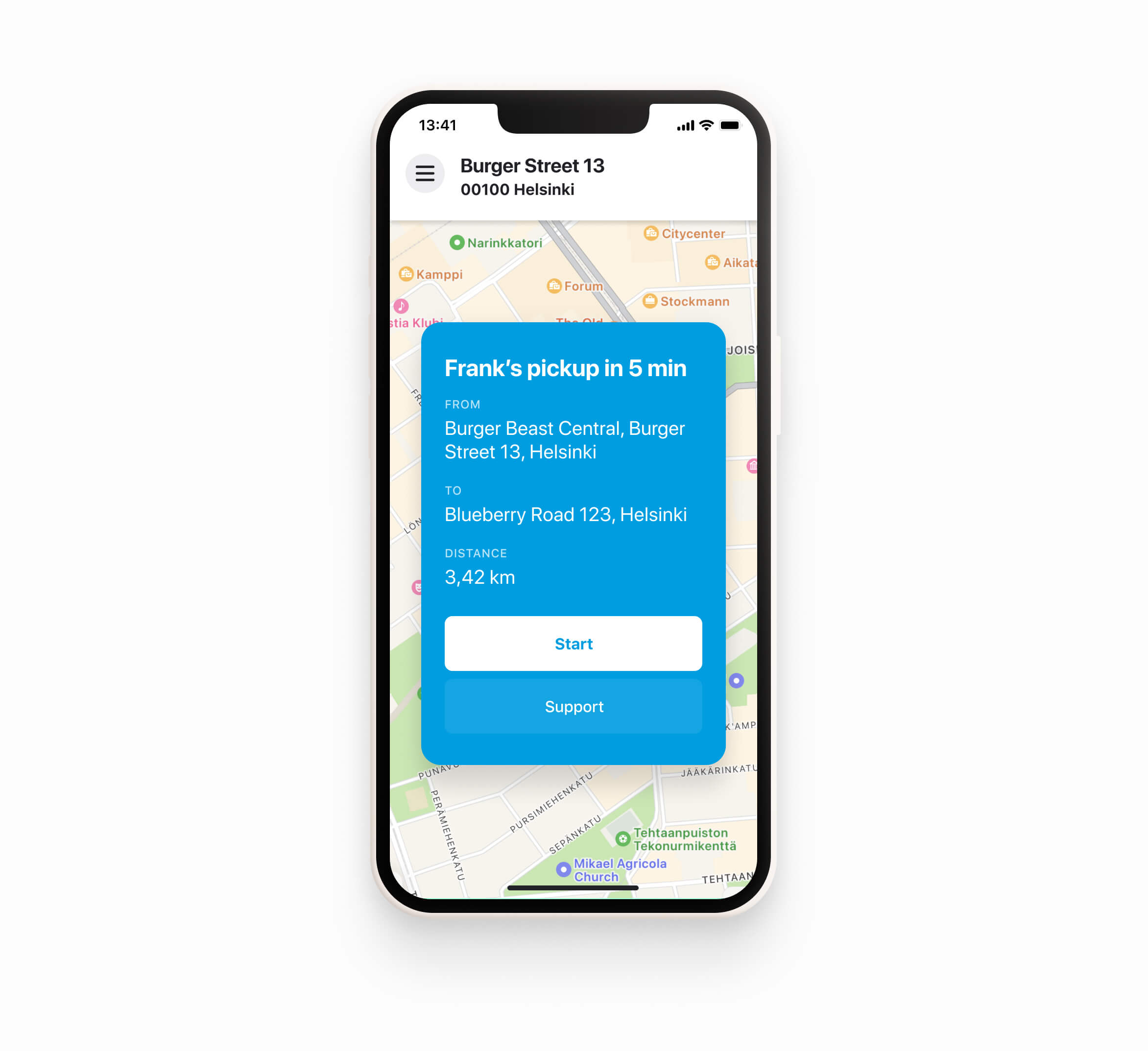
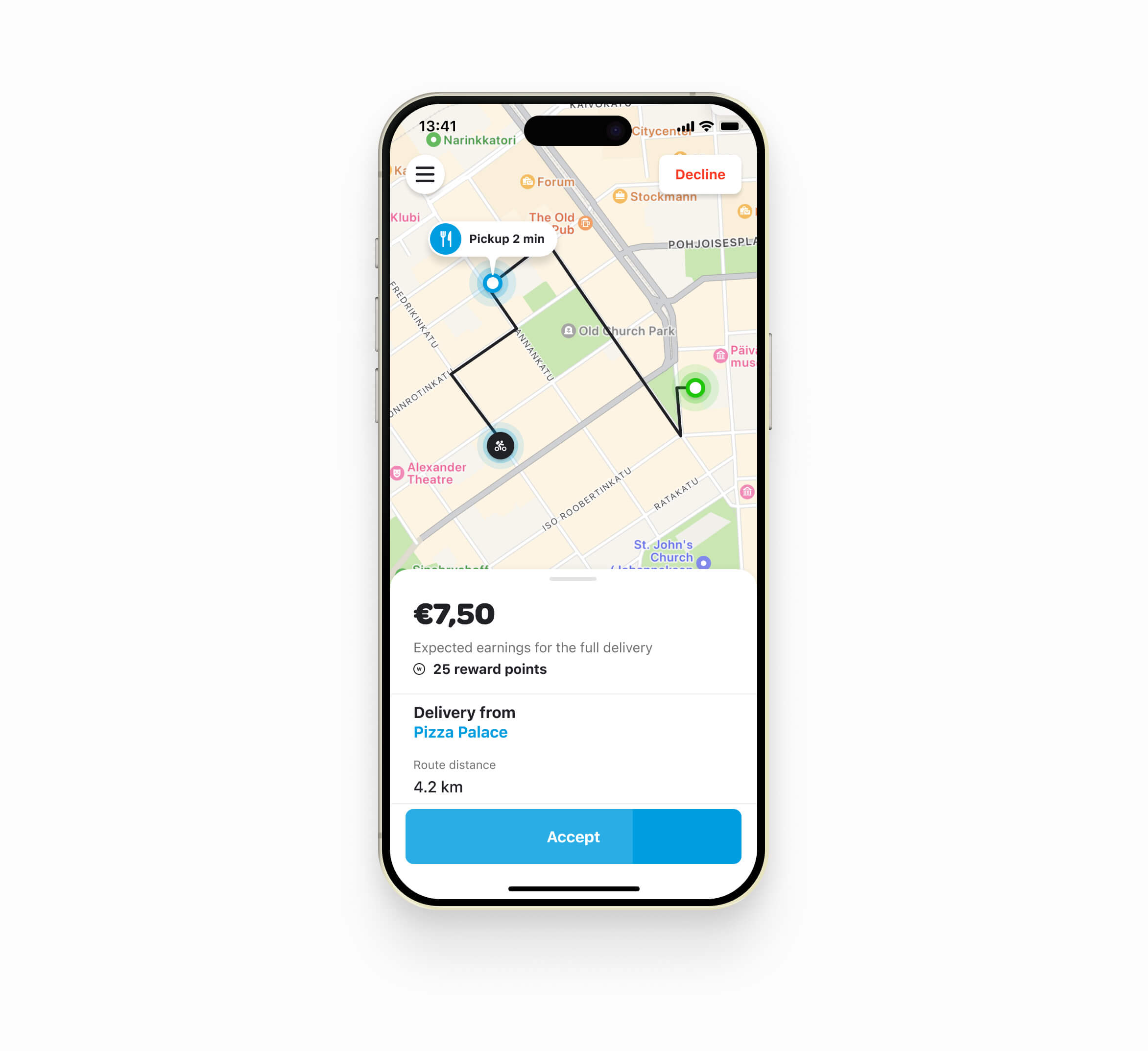
NEW TASK OFFER BEFORE / AFTER
At the same time, support contacts increased. A recurring pattern emerged where couriers accepted tasks quickly, without sufficient visibility into pickup and drop-off locations, and then requested cancellation once the task areas became clear on the map.
Through exploration and testing, moving from a blocking popup modal to an expandable bottom sheet proved to be the most effective solution in both the short and long term. The approach allowed information density to scale while maintaining speed and clarity during task acceptance.
Because this change required substantial technical rework, it was delivered incrementally to ensure service stability and reduce risk.
Even the first iteration, introduced before routing and upfront pricing, which surfaced only pickup and drop-off locations and their relative distance, led to a significant improvement in stability and a measurable reduction in support contacts.
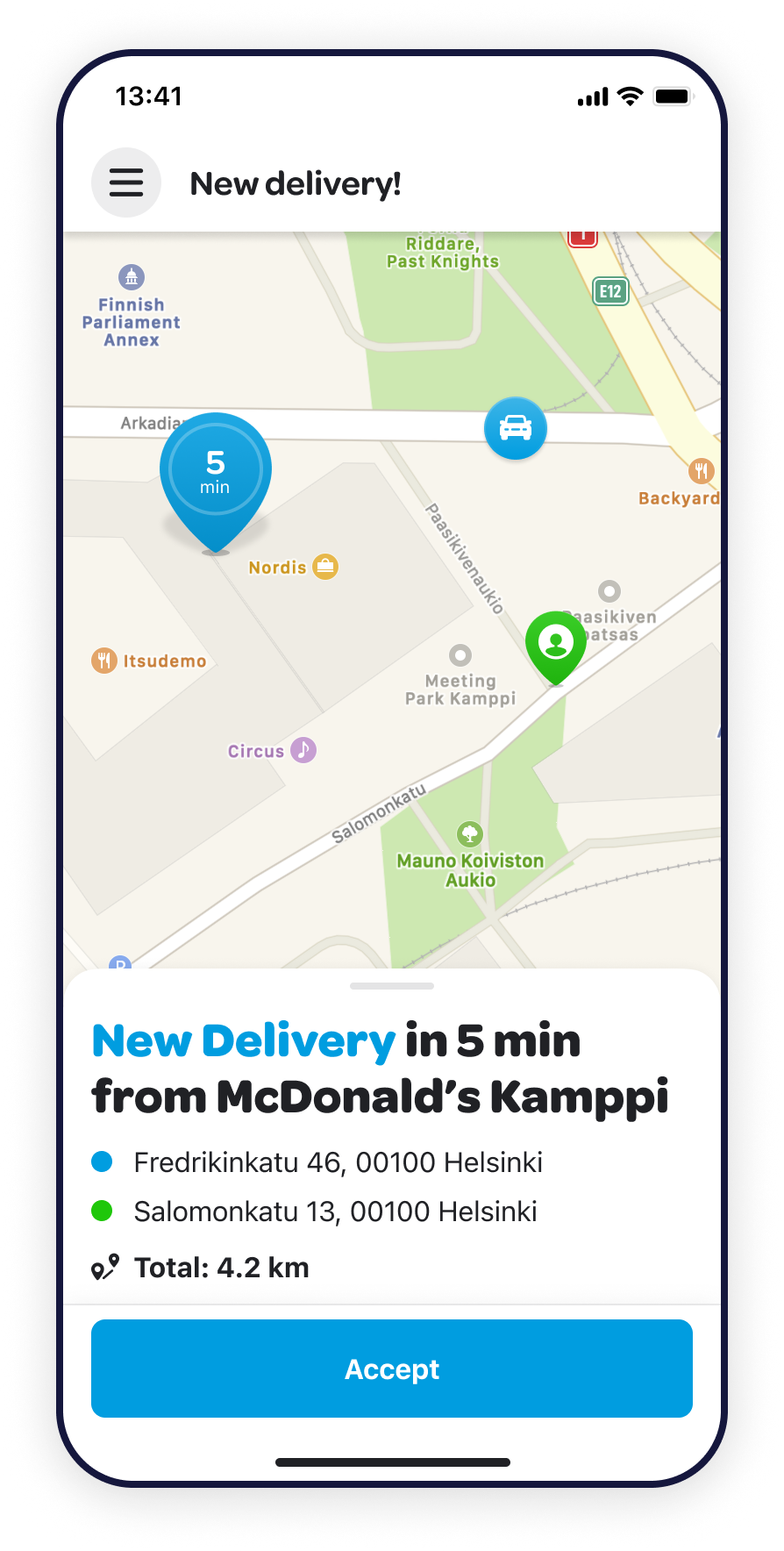
NEW TASK OFFER INITIAL UPDATE
Due to the scope of the required rework, the initial transition from a center-screen modal to a bottom sheet was intentionally conservative. This first step preserved the existing task information, focusing primarily on improving stability and task-area visibility. The only notable addition at this stage was the introduction of the updated brand typography.
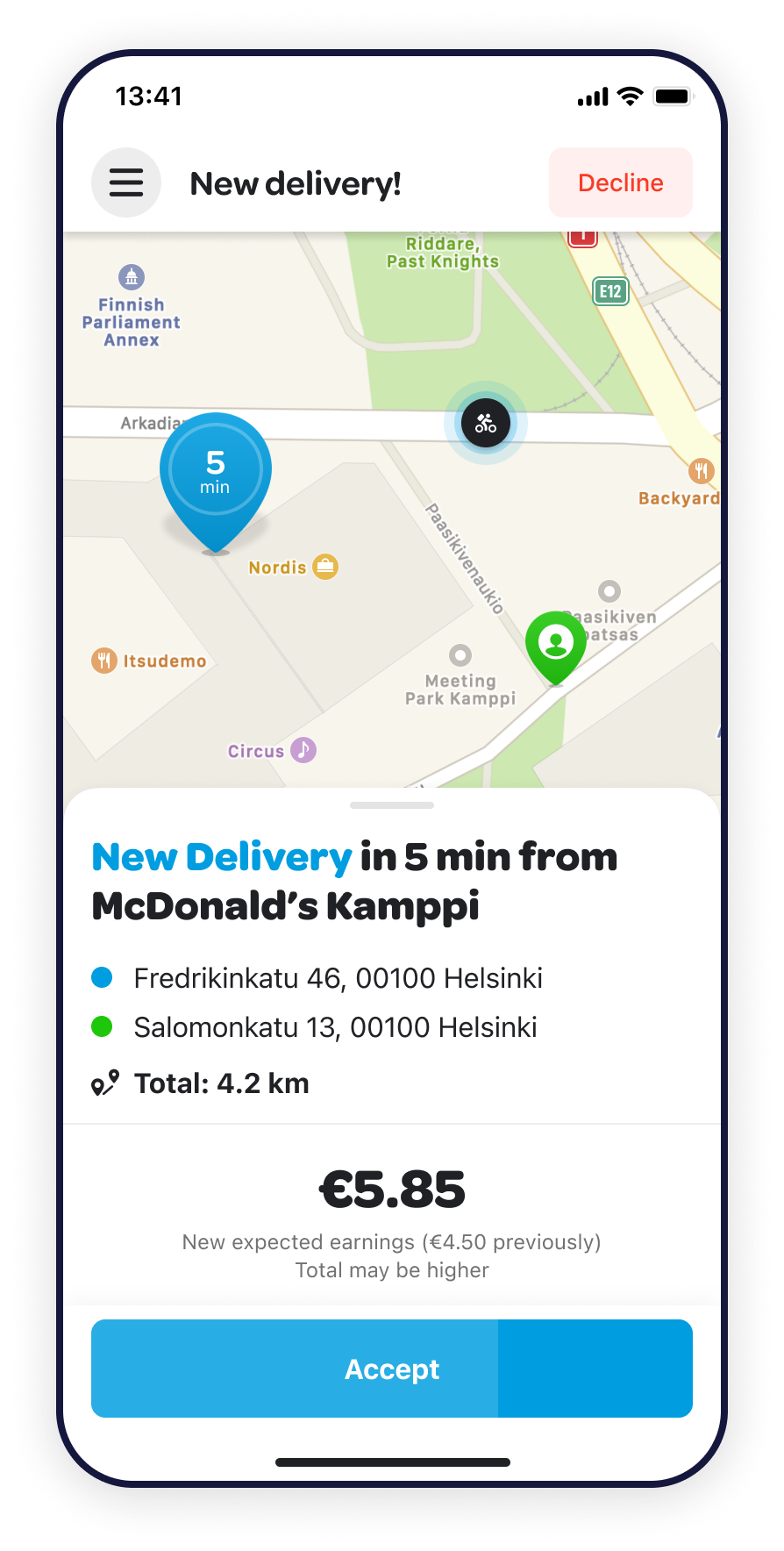
NEW TASK OFFER UPFRONT PRICING
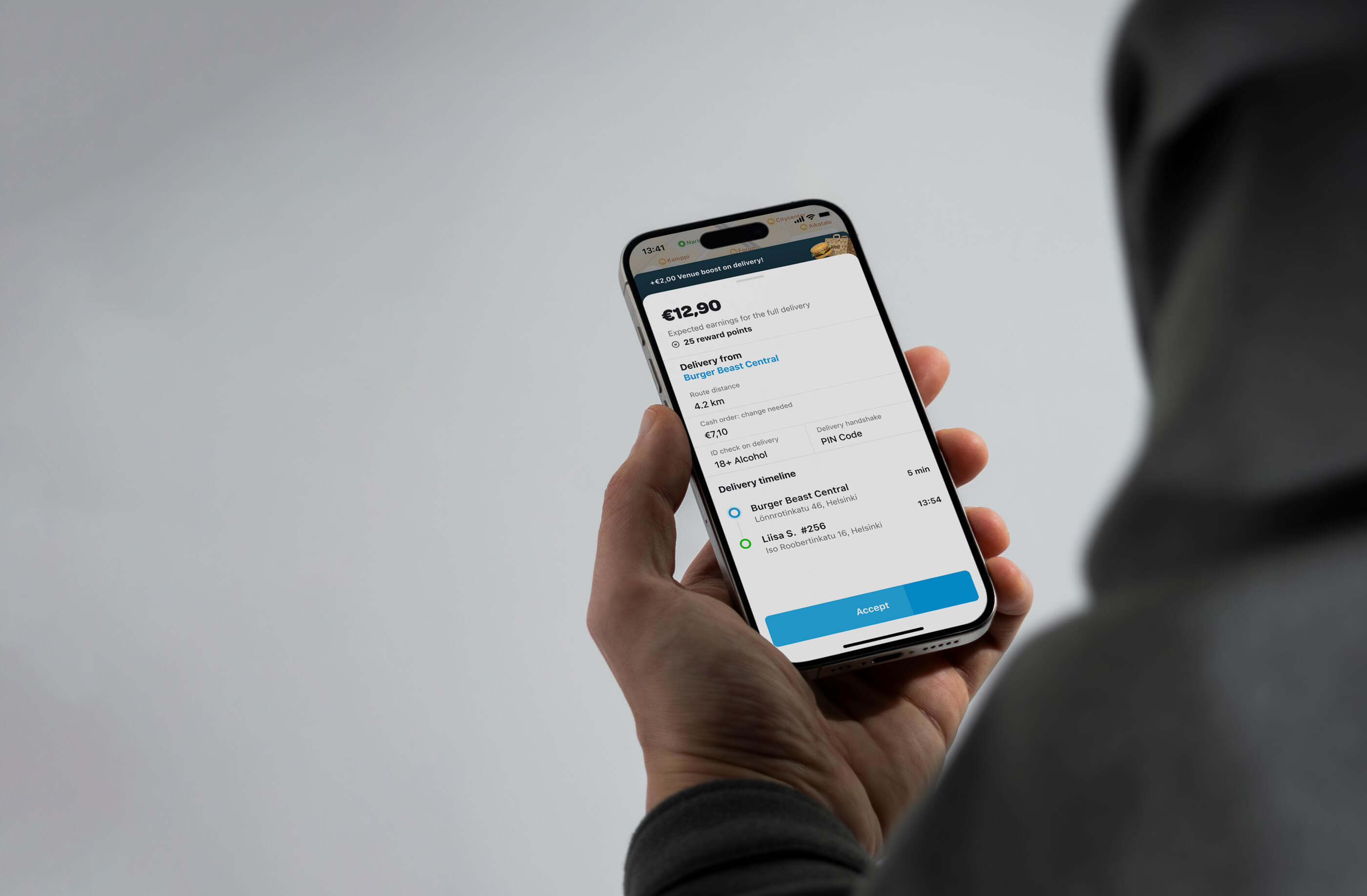
The next iteration introduced two major service-level updates: upfront pricing per task and an explicit option to reject a task.
Pricing, identified as a key driver of task acceptance, was placed in close proximity to the accept action. This placement was informed by competitive benchmarking, particularly learnings from DoorDash.
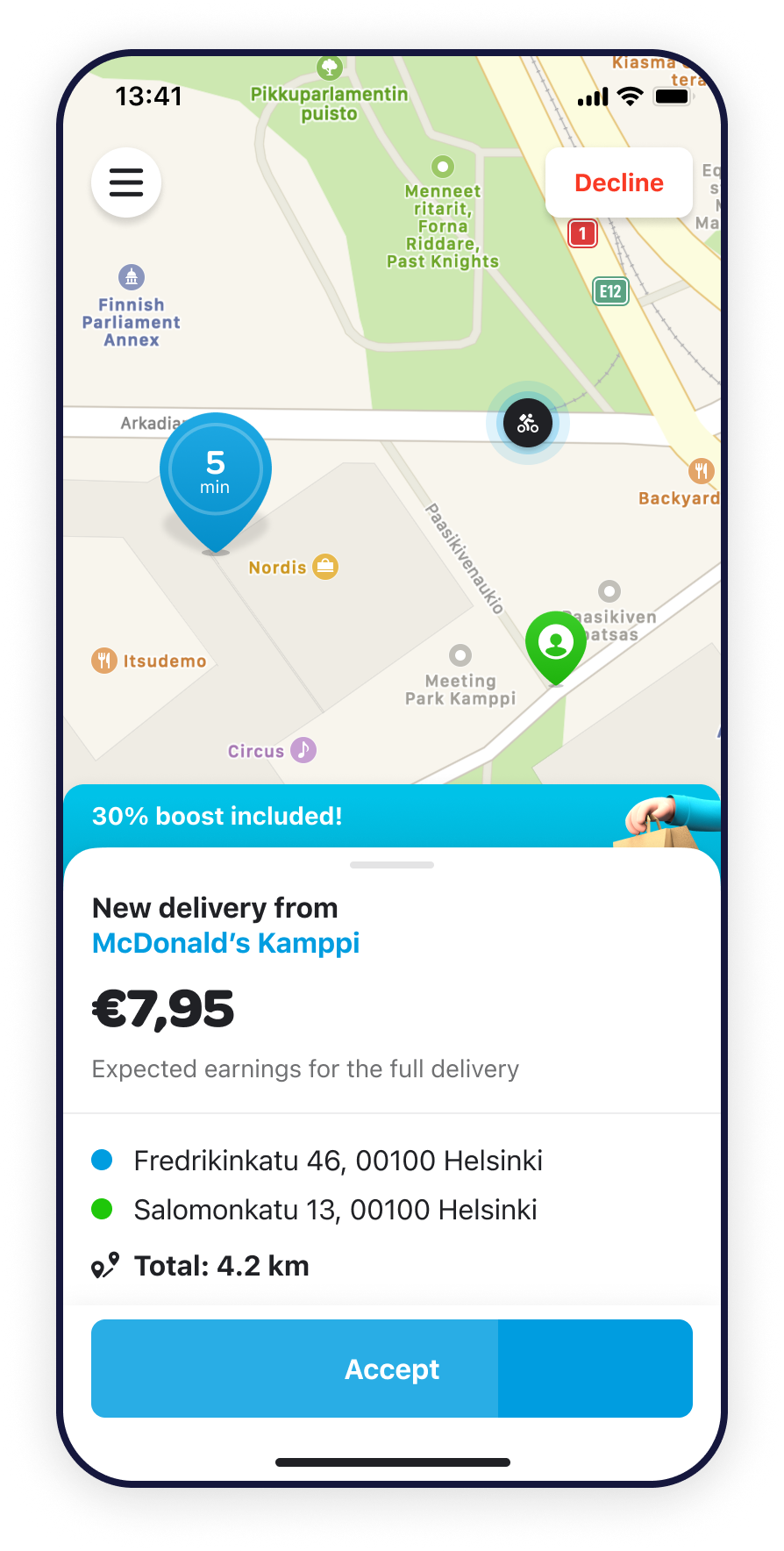
NEW TASK OFFER VERSION 2
A subsequent version further optimized the use of screen real estate, improving both map visibility and task clarity. This release also introduced task-based bonuses, such as venue extras, adding more transparency into potential earnings.
Ongoing research and courier feedback confirmed that price and perceived effort were the primary factors influencing task acceptance. As a result, these elements were progressively elevated in the task offer hierarchy to support faster, more confident decision-making.
Modernizing the task offer experience
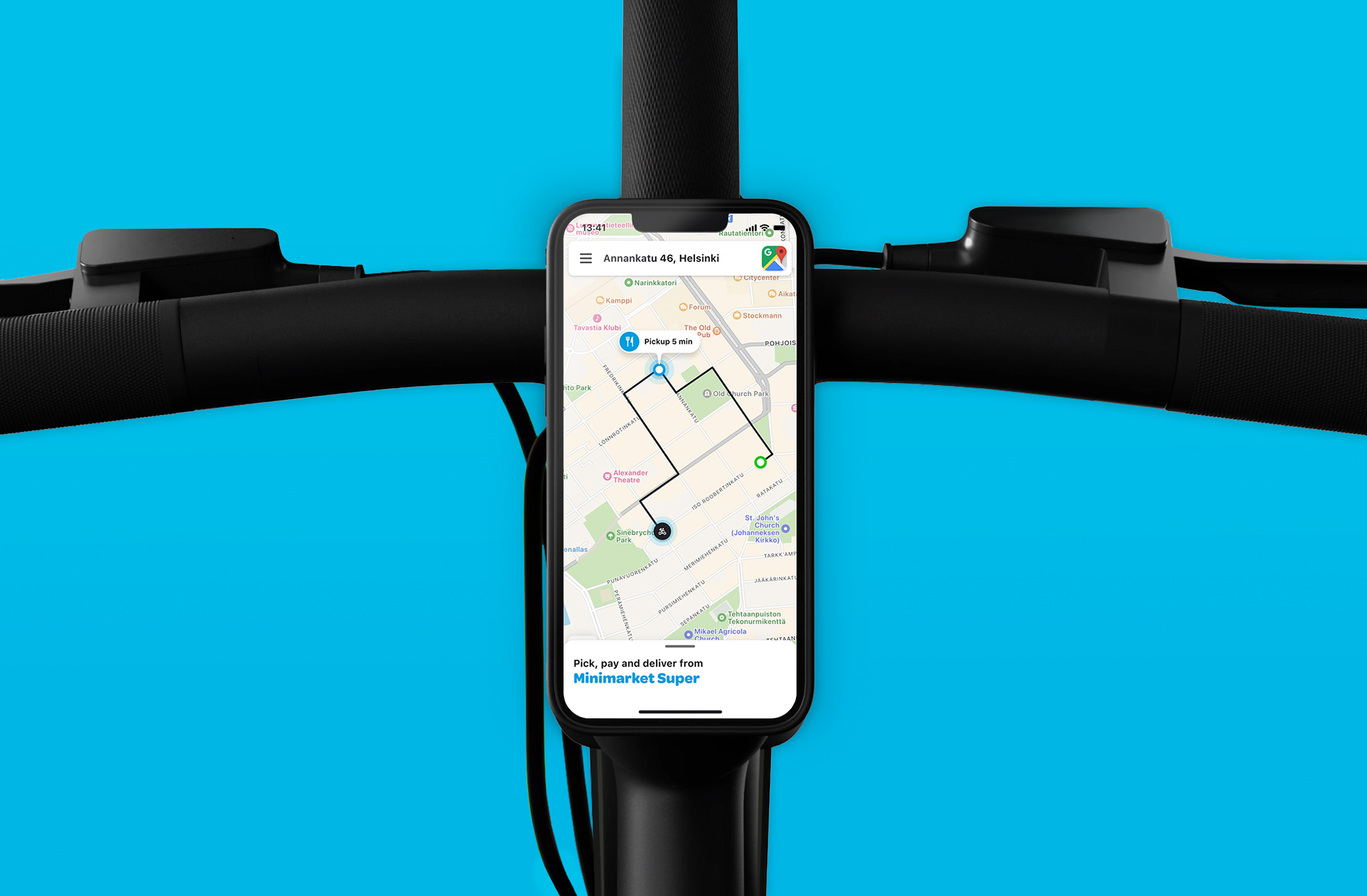
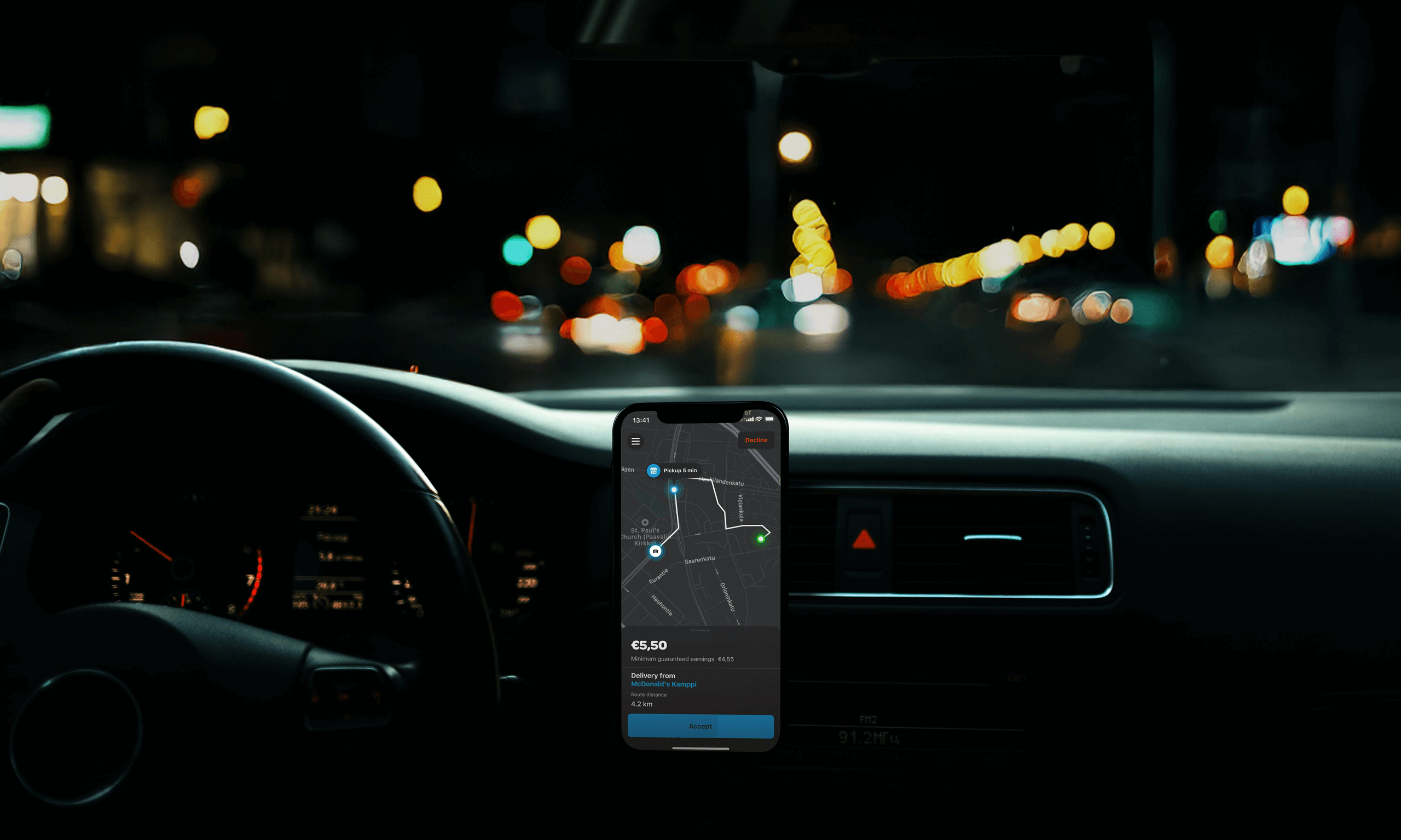
The latest iteration of the task offer introduced in-app routing, giving couriers clear visibility into the full route and greater transparency into task pricing, calculated dynamically based on the route. It also removed the requirement to launch an external navigation app after accepting a task, while still preserving the flexibility for couriers to choose their preferred navigation setup.
The focus shifted from expected arrival times, which often led to perceived lateness issues, toward a clearer representation of effort versus earnings. Combined with an expanded set of bonus types, streaks, and courier reward points, this further increased transparency and trust in the offer.
Thanks to systematic, well-defined design patterns, the task offer could be flexibly extended to support growing service complexity. This included bundled tasks, multi-venue pickups, and multi-address or multi-order drop-offs.
The same foundation also enabled clear communication of additional task requirements, such as age-restricted or regulated items (for example pharmacy orders), and delivery capability constraints including ID checks, cash handling, delivery handshakes, and similar conditions.
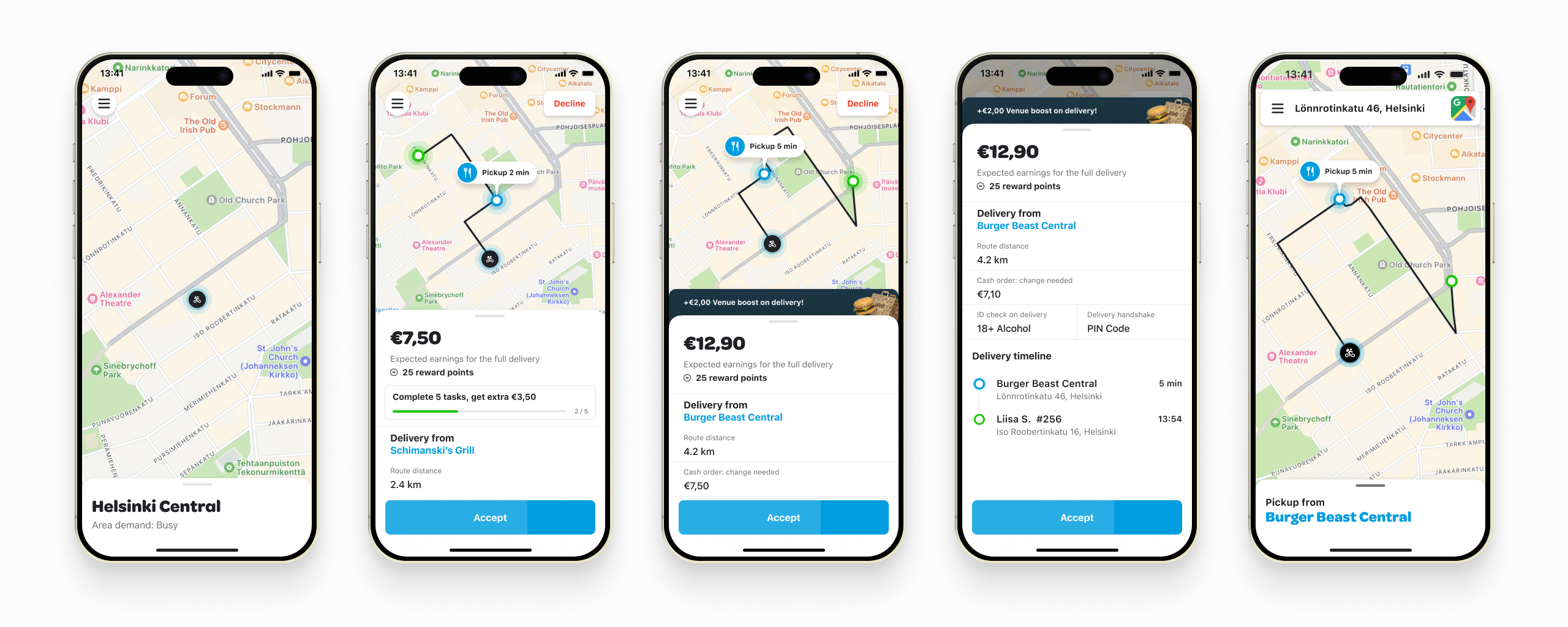
NEW TASK OFFER FLOW
TASK OFFER SHEET EXPANDING TO REVEAL MORE INFORMATION
Enabling self-serve control and task rejection
Enabling couriers to reject tasks without contacting support was part of a broader service update. This update also removed the earlier distinction between single and bundled tasks, which had imposed inconsistent and sometimes unclear requirements on couriers.
As part of the same rollout that introduced upfront pricing, universal task rejection became available to all couriers. A secondary confirmation step was added to prevent accidental taps and give couriers a moment to reconsider uncertain rejections.
The rejection flow includes a time-boxed countdown and a structured set of optional rejection reasons, prioritizing the most common and likely causes.
While providing a reason is not required, selected inputs are aggregated to identify patterns and weak signals across task types and delivery areas. These insights are used to continuously improve task quality and overall service performance.
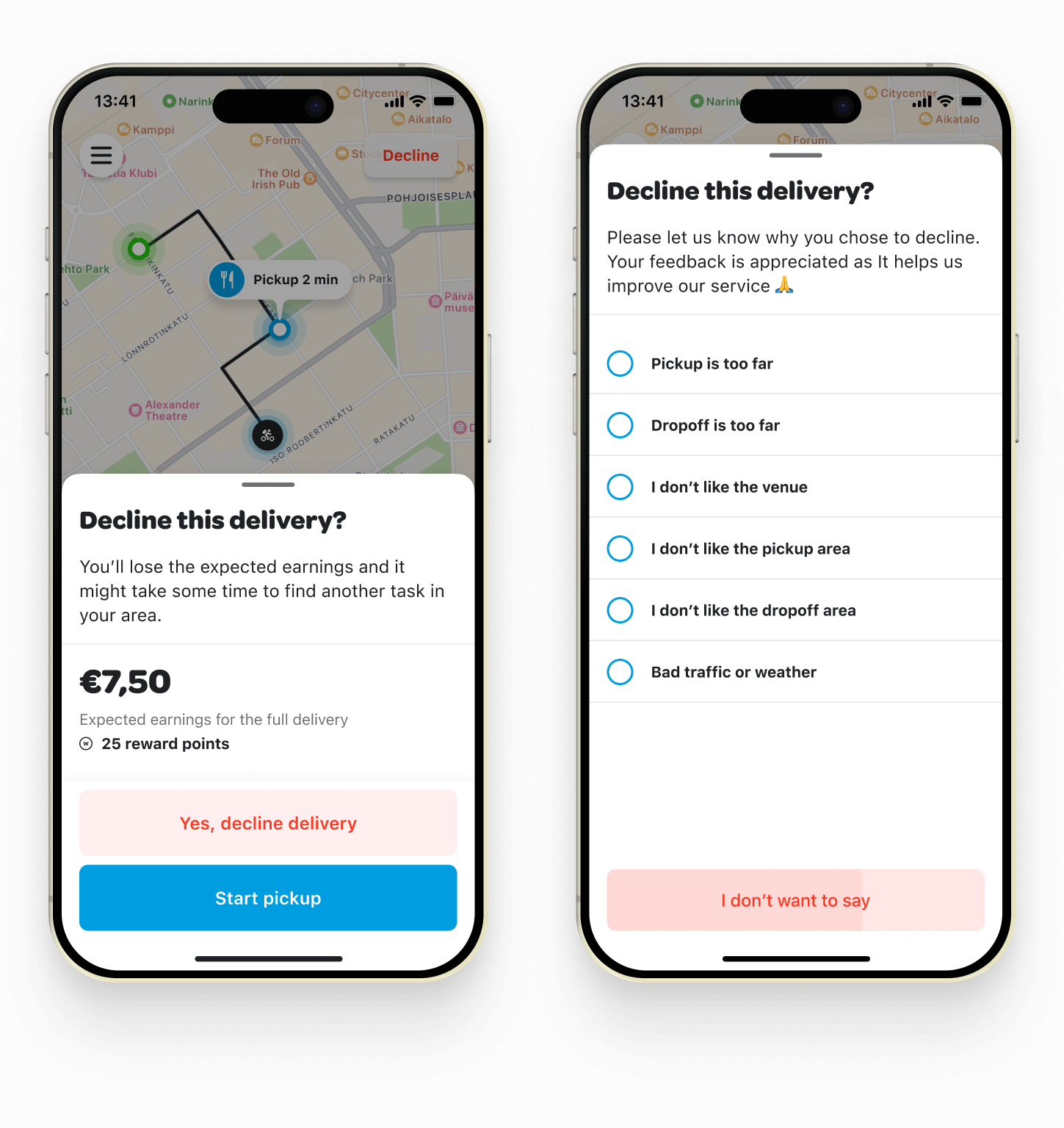
Improving the pickup experience
The pickup phase begins immediately after a courier accepts a task. Pickup sheets become available at once and can be expanded as needed.
These sheets present task-specific information such as items to be collected from a venue, merchant, or individual, and support in-place actions within a geofenced area. Actions include item confirmation, ID checks, and completing the pickup.
The original pickup experience was designed around a narrow use case: pre-paid restaurant deliveries. As task complexity increased, this approach did not scale well, largely due to a lack of clear structure and information hierarchy.
The first major redesign introduced a grouping model to bring order and consistency. Information was organized into sections covering venue-related details (navigation, venue notes), order details (order number, items), support actions, and the delivery timeline.
While this grouping and visual standardization improved clarity, the pickup sheet continued to grow in length and density over time. This increased cognitive load for couriers and raised the risk of errors, such as missed or forgotten side items.
LEGACY PICKUP SHEET
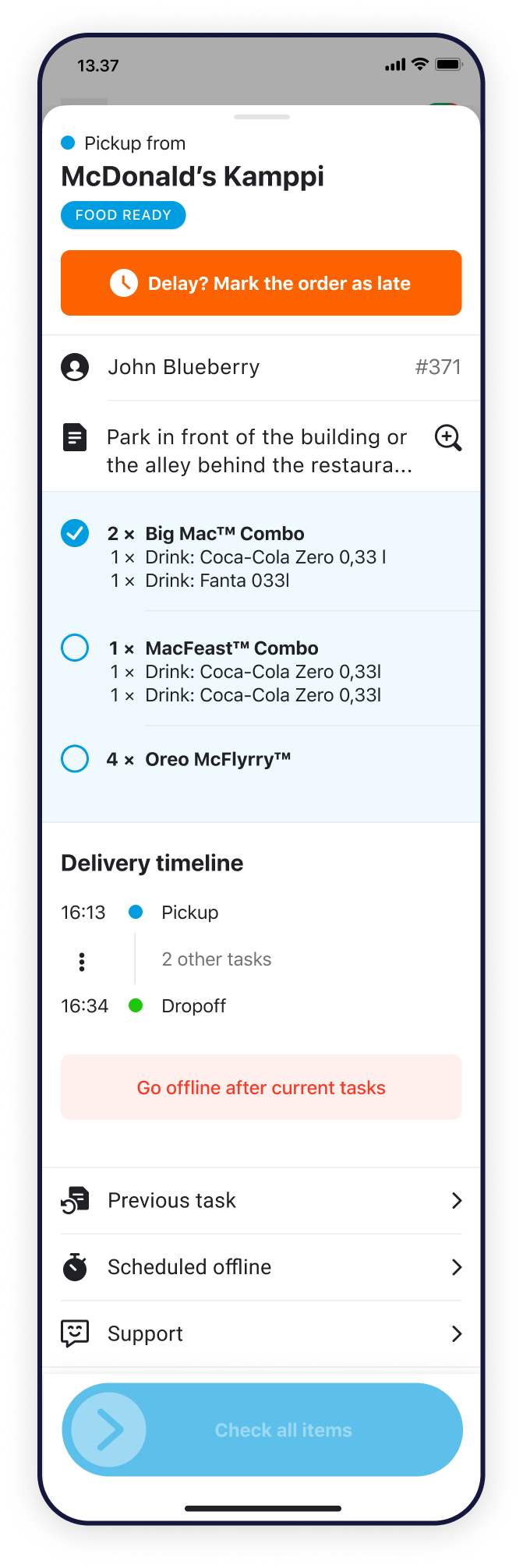
FIRST GROUPED UPDATE
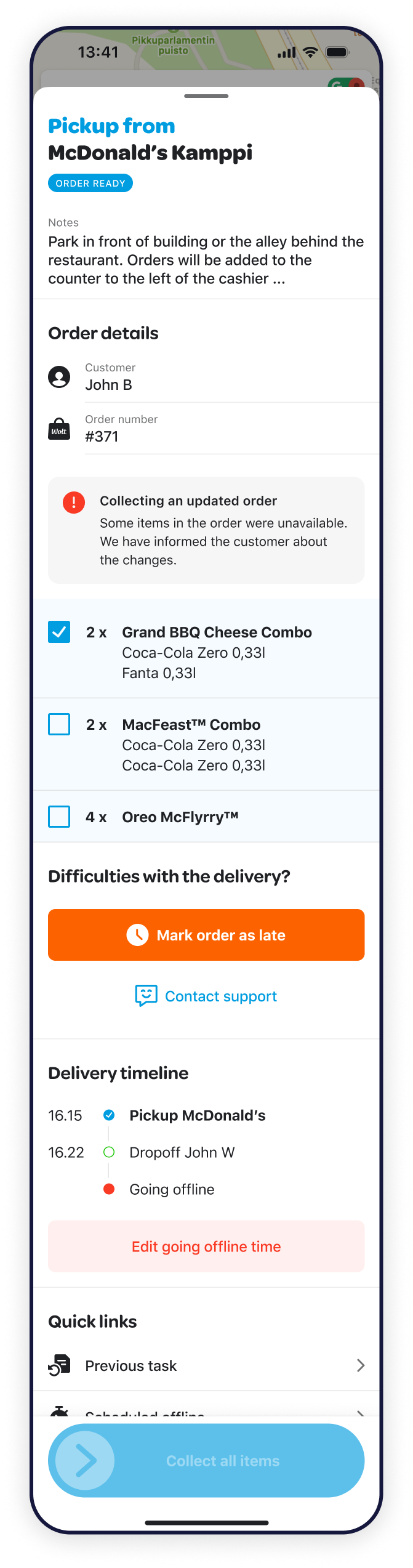
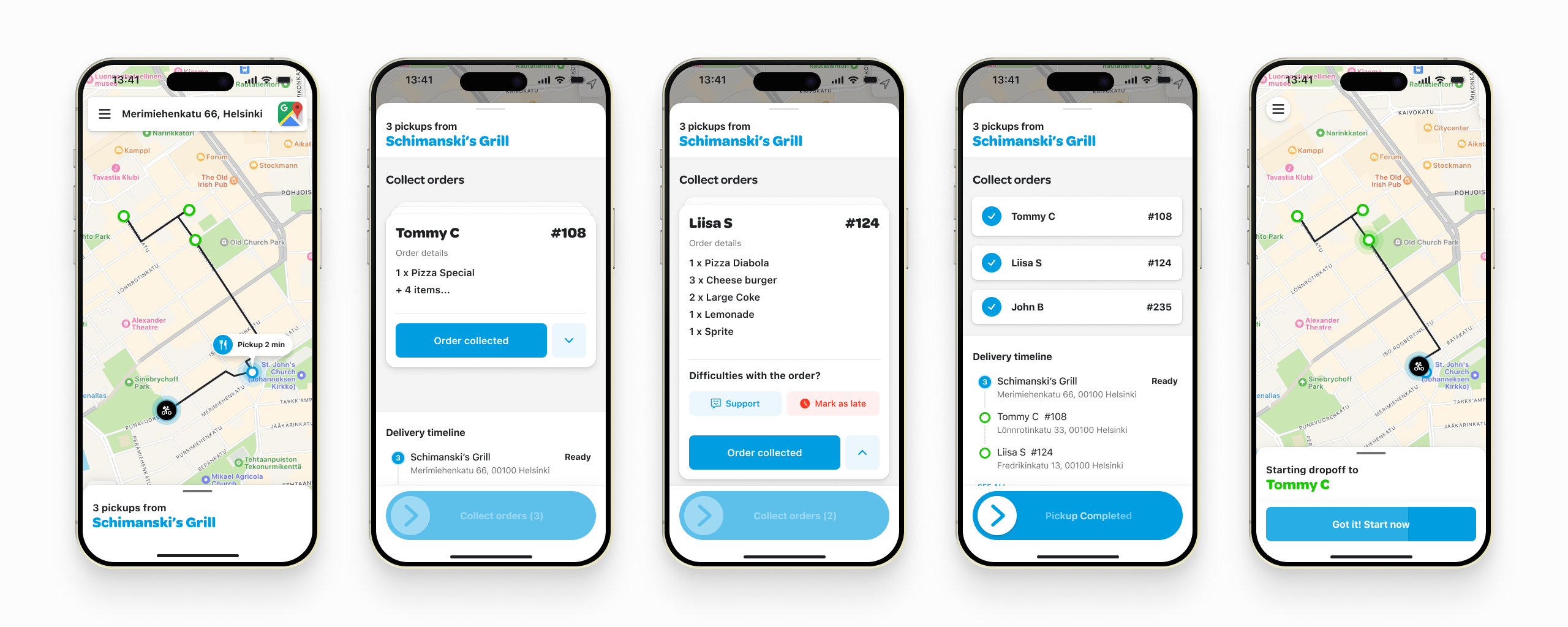
Structuring complexity through card-based pickups
The latest update to the pickup experience introduced a clearer hierarchy, stronger standardization, and more intentional grouping. The focus shifted to surfacing the right information at the right time, in the right sequence, reducing cognitive load during a high-pressure moment.
A card-based structure was introduced for each order, making pickup requirements explicit and easier to scan and complete. This separation of individual pickups also enables more complex scenarios, such as multi-customer tasks where multiple orders are collected from the same venue in a single visit.
At the service level, couriers were no longer required to verify individual item contents. As most merchants transitioned to sealed or closed bags for privacy and security reasons, item-level checkbox verification became impractical and was intentionally removed from the flow.
Once a pickup is completed, the task now transitions automatically to the next phase. This improves efficiency and reduces the risk of couriers forgetting to manually advance the task state.
Improving the drop-off experience
As with pickup, drop-off sheets become available and expandable in the core delivery flow once the pickup is completed.
They surface task-specific information such as delivery details and instructions, and are actionable by default within a geofenced area near the customer, enabling couriers to complete the drop-off at the appropriate location.
The drop-off experience was a focus area in a broader, cross-product design initiative to standardize and unify how customer addresses are structured and presented.
This introduced a systematic approach to how address data is captured in consumer products and rendered in the courier app.
By applying clear logic and consistent structure across different address types, from apartment buildings to curbside drop-offs, cognitive load was reduced. This led to fewer delivery errors, fewer support contacts, and faster, more reliable deliveries overall.
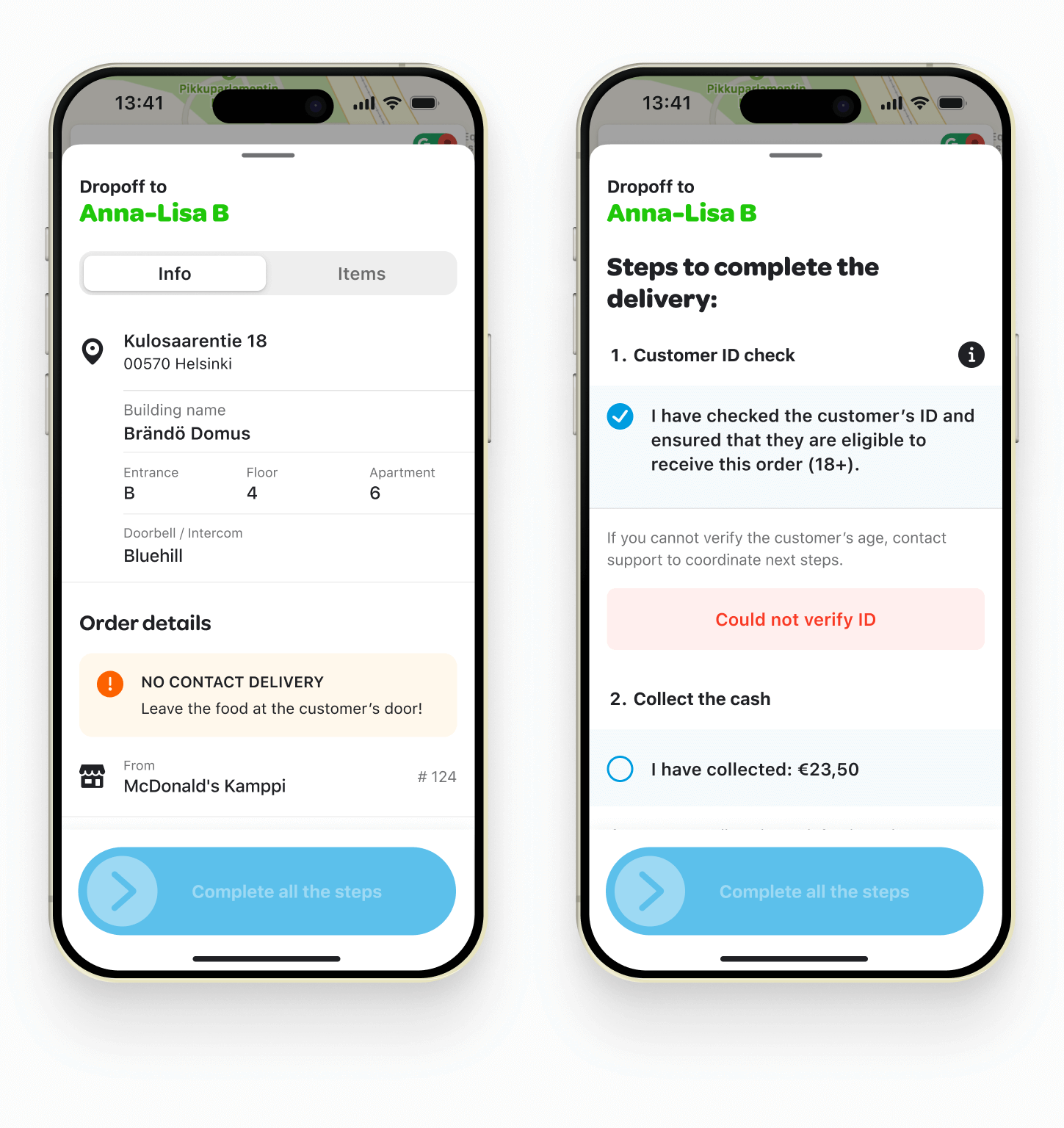
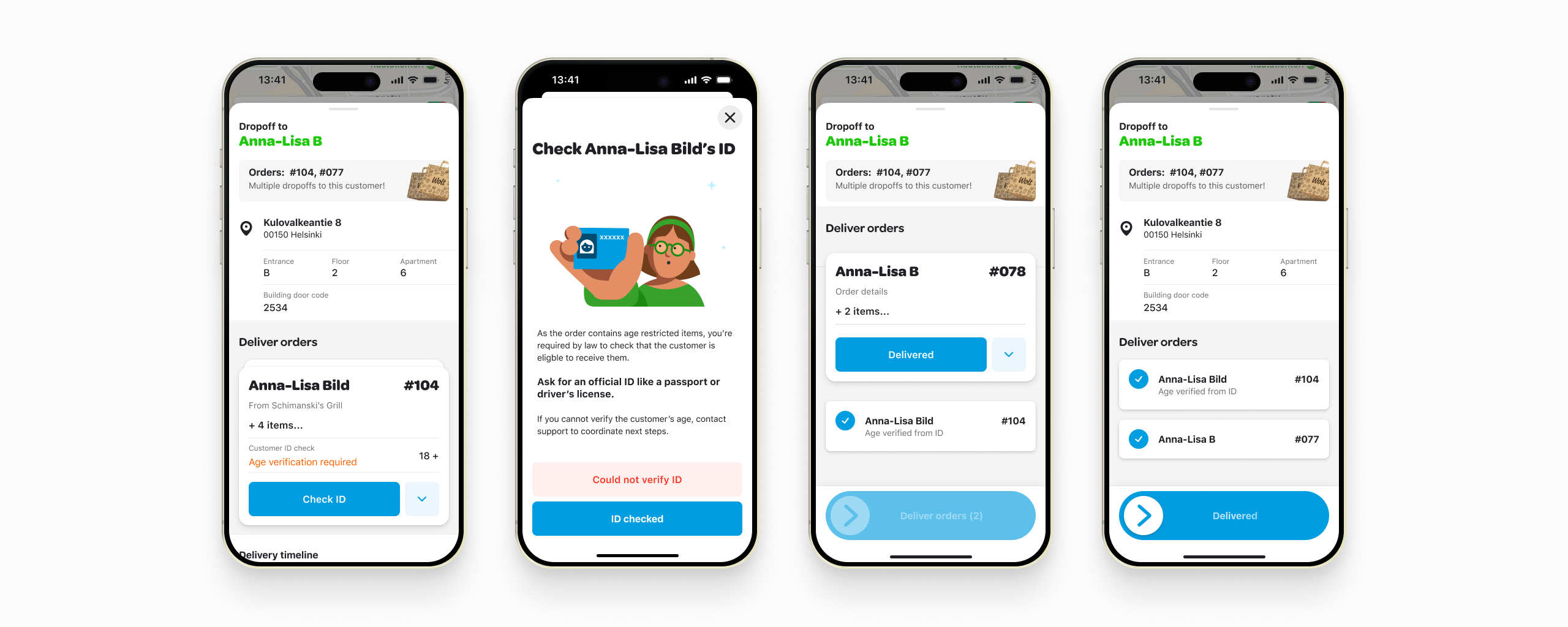
DROPOFF SHEET INTIAL AND SCROLLED VIEWS
While the updated drop-off sheet benefited from clearer structure and familiar formatting, the growing set of requirements for newer delivery types, such as age-restricted items, began to introduce new challenges.
As additional steps were layered into the flow, the sheet became increasingly long and complex. In some cases, critical actions, such as entering a delivery handshake code required to complete deliveries of higher-value goods, were pushed far down the page, increasing friction and the risk of missed steps at the point of delivery.
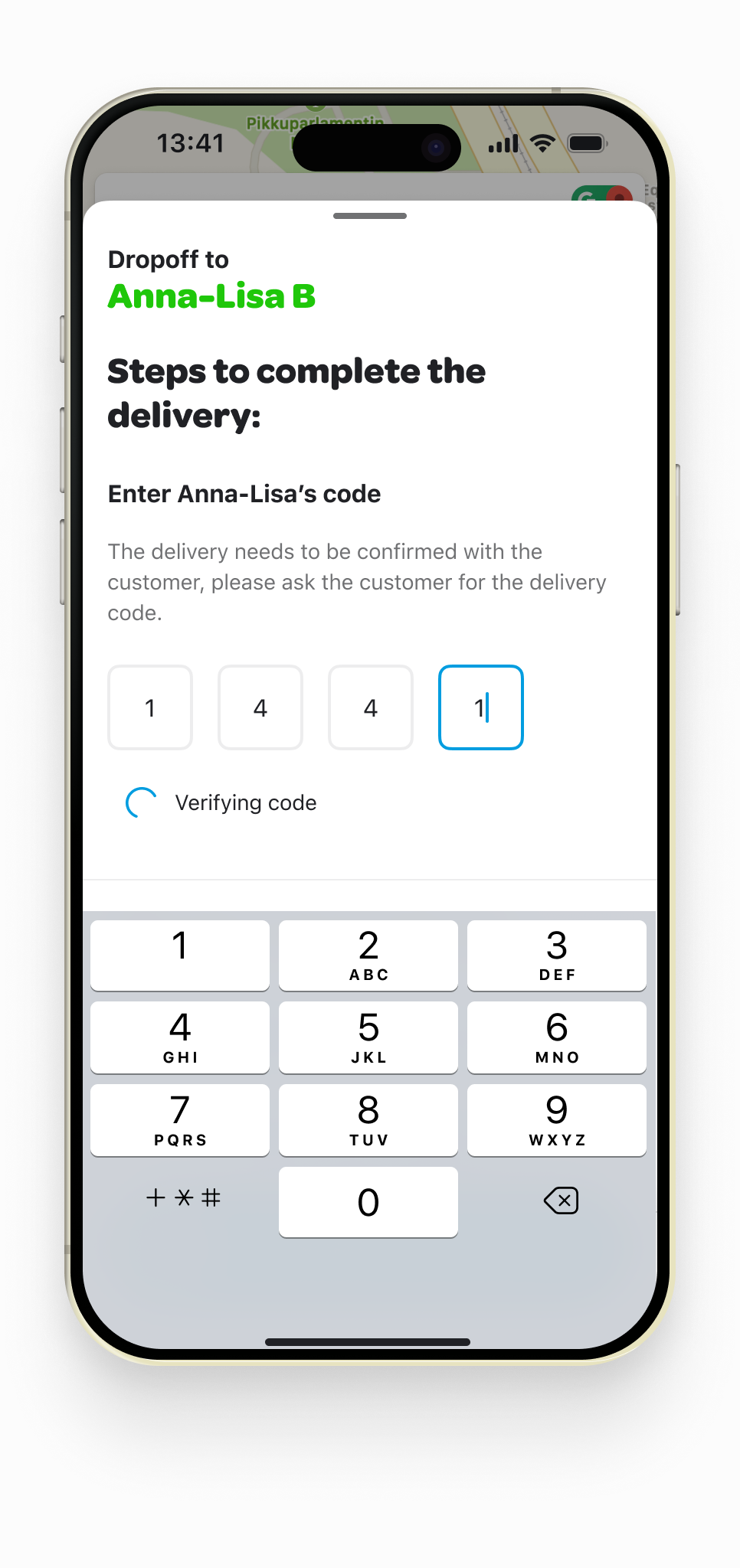
The latest drop-off update mirrors the pickup evolution, moving toward a more hierarchical, standardized, and clearly grouped structure.
The goal is to further reduce cognitive load by explicitly separating information, required steps, and actions. A card-based approach makes the content of each order, and the requirements to complete that drop-off, easier to scan, understand, and execute at the moment they matter.
By introducing expandable cards per order, the experience is also future-proofed to support increased complexity. This includes scenarios such as pick, pay, and deliver from retail stores, as well as delivery models that have yet to be defined.
Expanding the task experience beyond deliveries
The task experience was intentionally designed as a scalable platform rather than a single-purpose delivery flow. By establishing and enforcing unified, systematic structure across task offers, pickups, and drop-offs, new task types could be introduced without fragmenting the experience or increasing cognitive or operational overhead.
This foundation enabled the expansion from restaurant deliveries into more complex tasks such as pick, pay, and deliver in grocery and retail.
Despite introducing new requirements, including in-store navigation, substitutions, and payment handling, these tasks fit cleanly into the same core task loop.
The impact for couriers is meaningful. A broader mix of task types increase task density per hour, reduce idle time, and improve earning stability across shifts, particularly during off-peak periods.
Higher task density per hour or shift, combined with increased earning potential and other satisfaction drivers, help reduce churn among high-performing couriers and strengthened Wolt’s position as the preferred platform for courier partners.
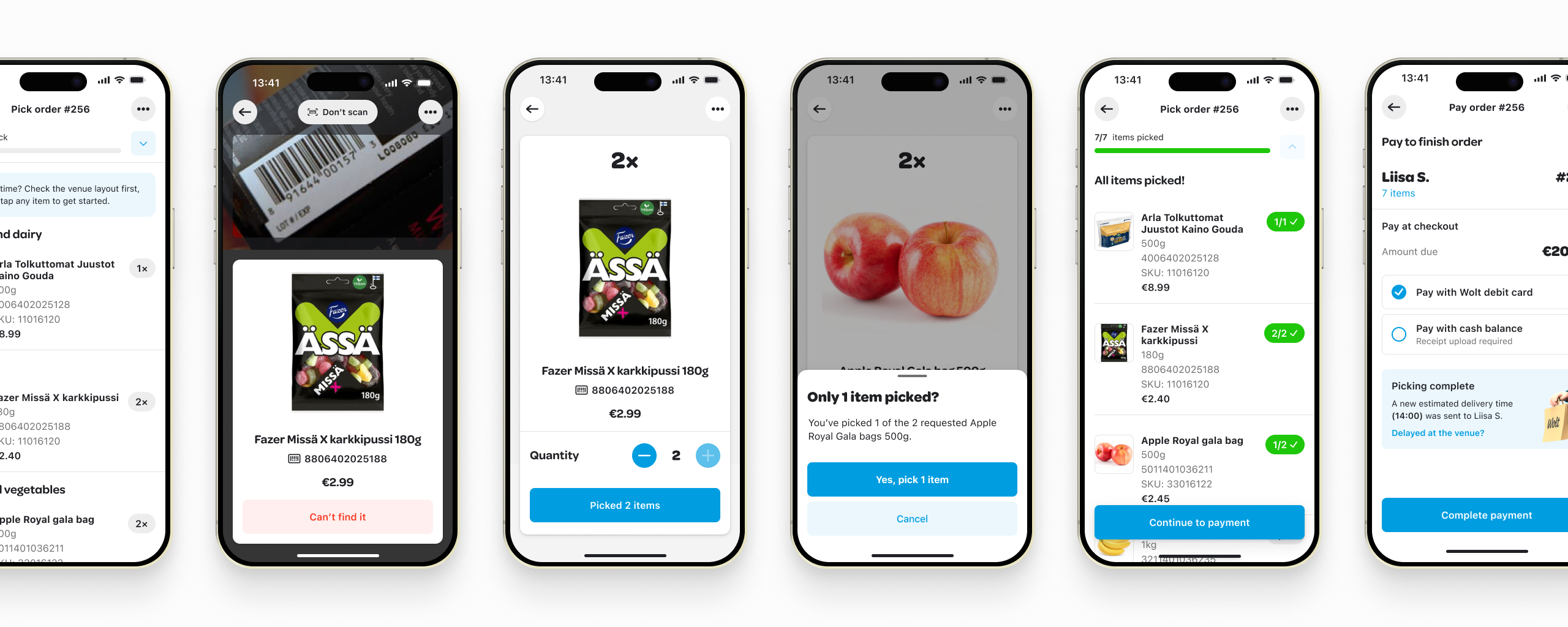
EXPANDED TASKS COURIER PICKING
Supporting couriers through performance transparency
As part of the ongoing effort to deliver a fundamentally better partner experience and position Wolt as the preferred platform, an Insights section was designed and introduced in the app.
Together with supporting views such as detailed earnings breakdowns by day, shift, and order, Insights gives couriers clear visibility into how they are performing on the platform. This includes metrics such as booked versus worked contract hours, task acceptance rate, and deliveries per hour.
For employee couriers in particular, transparent access to contractual obligations, performance indicators, and practical guidance on how to succeed in their role proved both critical and highly valued. By making expectations and progress visible, the experience strengthened trust, supported growth, and reinforced the partnership between couriers and the platform.
Driving retention through loyalty and incentives
Courier rewards were introduced to recognize and incentivize the daily work of couriers, drawing on proven loyalty models across comparable platforms. The program offers tiered benefits, both material and experiential, in addition to standard task compensation.
Couriers earn reward points by completing tasks in the app, such as deliveries, with progress and benefits made visible to support motivation and goal-setting.
The program launched as an MVP in a small number of strategically selected markets where demand for such features was strongest. Based on early adoption and feedback, it was iterated on and subsequently expanded to additional markets with applied learnings.
With clear targets, evolving benefits, and transparent progress, the rewards program has been well received. It has increased engagement and contributed to stronger retention, reinforcing Wolt as the preferred platform for courier partners.
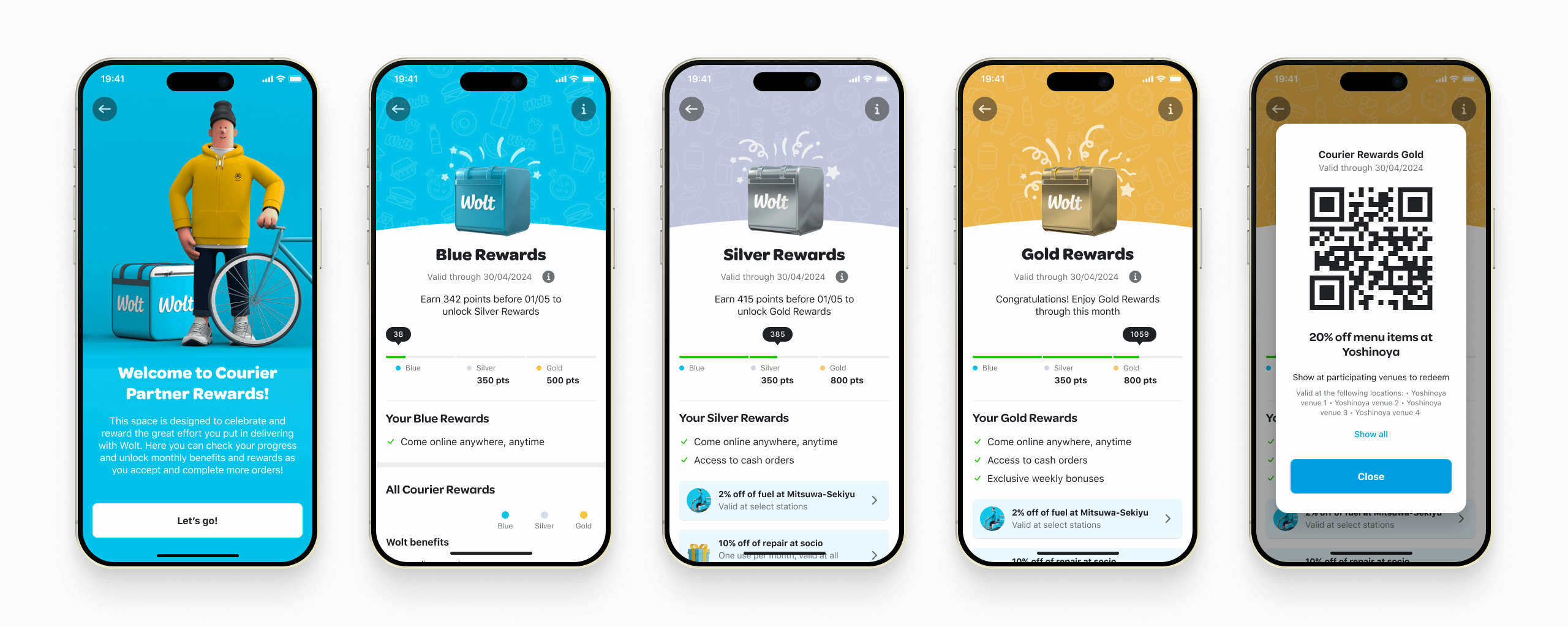
COURIER REWARDS PROGRAM PHASE 1
Outcomes, impact, and ongoing design ownership
By consistently prioritizing a better partner experience alongside a robust, scalable design foundation, the courier app evolved into a platform capable of absorbing future requirements well. This shift significantly accelerated product development while maintaining coherence across an increasingly complex service.
The app today supports tens of thousands of couriers across multiple markets, operating in diverse regulatory, contractual, and operational contexts. Designing at this scale required solutions that were not only usable, but systematic, resilient, and adaptable to variation without fragmentation.
Elevating the in-app experience and focusing on fundamentally better usability enabled the platform to better serve both business and courier needs. Improvements to transparency, control, and decision-making strengthened trust in the partnership and increased preference for Wolt as the platform of choice in many regions.
Expanding the range of supported task types, such as picking alongside traditional deliveries, materially improved earning opportunities for couriers. Combined with greater autonomy, clearer expectations, and performance visibility, these levers contributed to higher overall satisfaction and stronger long-term engagement.
From a design perspective, this work reinforced the importance of treating design as infrastructure, not surface. The balance between speed and quality became an explicit concern as the product and teams scaled. While execution velocity is critical, the risk of quality erosion, inconsistent interpretation, and insufficient handoff documentation increases rapidly in multi-stream environments.
Sustaining progress required continuous design ownership. Maintaining and evolving systems, components, and patterns, intent and rationale as well as actively advocating for consistency across teams and organization. This ongoing ownership ensured the platform could continue evolve, without compromising quality or the foundations that made that possible.